Oak and rock: Same time, different houses
A look at two different houses. Both were built around the same time, somewhere between 15th and 16th centuries, but they couldn't be more different.
John Heseltine
11/25/20257 min read
Five hundred years ago nearly everything was regional, simply because moving anything farther than the distance you could carry it was very difficult and exorbitantly expensive.
You used things that you could source close to where you lived and you ate the things that grew around your house, and that was it.
Regionality means very little now - it's a lifestyle choice; you can choose to eat locally, but it's not forced on you. Right now I could order a Chinese, or Indian, or Italian meal from my sofa and the farthest I would have to move is from the sofa to the front door to take it from some poor sod on a bike. The food has probably come from a catering operation in a nearby industrial park that churns out Chinese, Indian, and Italian meals for people who may or may not realise that what they are eating bears little resemblance to food actually eaten in China, India, and Italy.
Food, and particularly take away food, now represents a fantasy of regionality - it's food from a place that doesn't really exist.
Choice has exploded. Even as recently as the mid 70's, as a 20-something year old living in Manchester, choice was limited. You couldn't just decide to eat a salad in the middle of winter - well, not unless you really liked shredded cabbage and grated carrots.
Tomatoes didn't appear in the shops until the end of spring and they disappeared again at the end of summer. The best way to make sure you got to eat some real salad (if you truly didn't like cabbage and carrots) was to put a reminder in your calendar.
And it's the same with buildings. The further back in time you go the less choice people had, and with very old structures the builders had almost no choice at all. They worked with materials that they sourced from near by and they used techniques that were also very local.
So if you were building a house five hundred years ago and you were surrounded by oak trees, then that's what your house was going to be made of. If you were in Wales near the mountains and you wanted a roof, then it would be made of grey slate. If you lived near reed beds then your roof would be thatch. Just like Henry Ford's choice for his customers, "You can have any color you want so long as it's black".
Unless you were very rich, your choices would also probably be limited as to how big your house would be, and where the animals would go. The style, shape, and size of your house were all going to be determined by the region and local conditions. No one would have expected otherwise.
Which brings me around to what I was up to last week.
I have a friend named Paul, who - like me - owns an old house. Interestingly, both houses were built at about the same time, somewhere from the late 1500s to early 1600s.
Apart from being old, the houses have almost nothing in common. Being in the mountains, mine is constructed of rock with a rubble infill in the walls, because we have more rocks and rubble than you could ever possibly need.
The beams and the floors are made from chestnut because it grows everywhere and makes great building timber. And the roof is constructed of handmade tiles, probably local, made from clay left here by the glaciers in the last ice age, which ended about 11,500 years ago.
There are no rocks near Paul's house, but when it was built there were probably plenty of oak trees. His house has a timber frame made with oak beams and it has oak floors. His walls are made with wattle and daub, because I really, really, seriously doubt that there was ever a shortage of mud in the UK.
His roof was originally made from thatch because he lives near several rivers and reeds grow everywhere. Plus, reeds are easy to transport because they don't weigh much, and you need, like, three tools to build a roof.
We have two very different houses, built out of different materials, but both performing the same function. So let's have a look at Paul's house. Here's the inside:

I would have also included a picture of the outside but it's not the easiest of places to photograph, as you can probably see from the track up to to the house, which looks like this. His place is off to the left hiding behind the gloriously out of control hedge on the left.
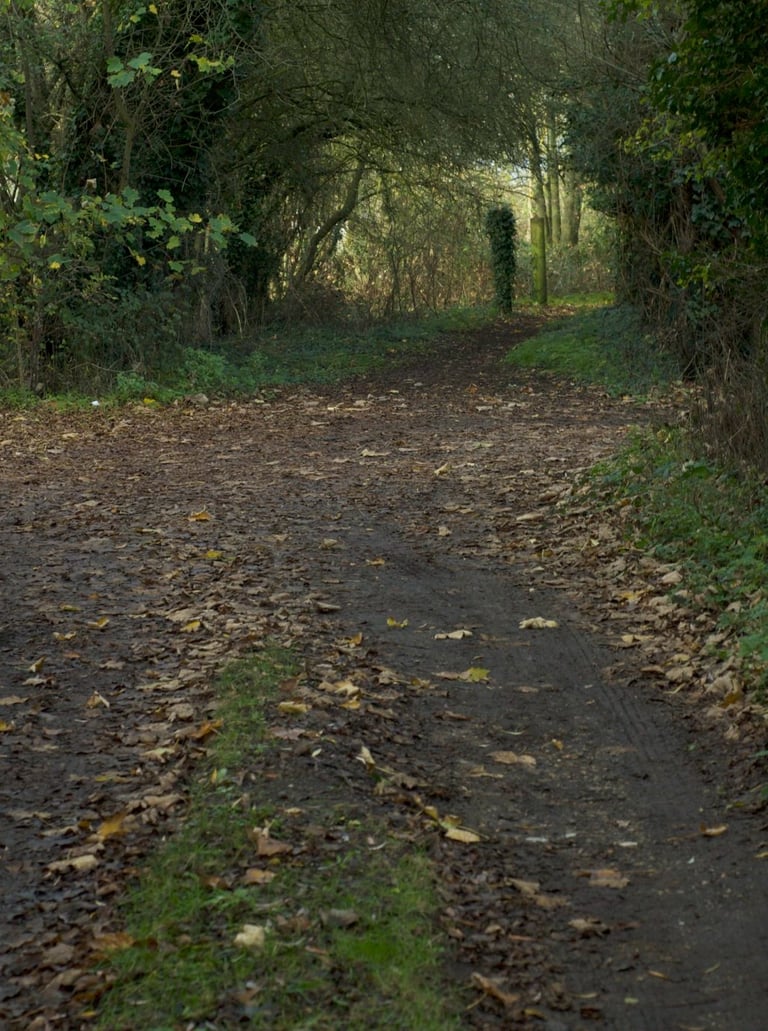
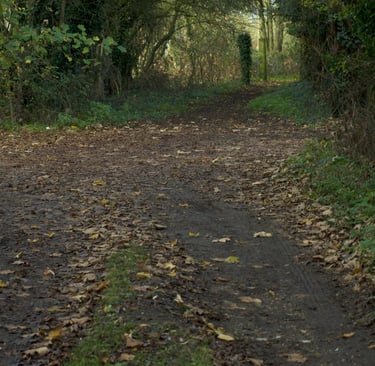
The hedge is probably an act of defense against all the clipboard-wielding officials who develop an unhealthy interest in your house as soon as you own a Grade II-listed historic property.
Our plan was simple. Paul needed to put windows into his house; he knows how to work wood and I know how to work steel, and the windows needed both. I was going to be in the UK and had some free time, and it all just magically came together.
These windows were not going to be your normal, run-of-the-mill, double-glazed PVCs units. They had to be as close to the original construction as we could get, which meant they needed to be leaded glass.
For those of you not familiar with a medieval leaded glass window, this is what it looks like.
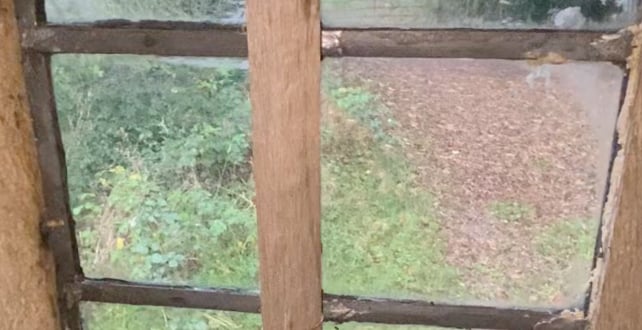
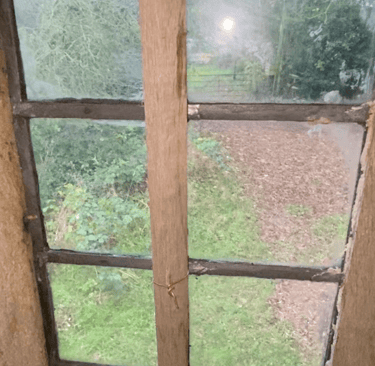
In times past, glass makers did not have the technology to make large sheets of glass. They could only make small squares like the ones above. To make a decent-sized, usable windows, they would set the small squares into strips of lead to combine them. This is the same method used to make stained glass windows, which typically combine lots of small panes of different colours.
My task was not to make the individual glass panes but to construct the metal frames that the windows needed to sit in. The one above is set into a wooden frame and doesn't need to open. But to make an opening casement window, the glass and lead need to be set into a steel or wrought iron frame. This is then fixed into a wooden frame, which in turn fits inside the oak framing of the house.
So we got to work. Paul has a lot of tools that are great for working in wood, but not a lot for metal, so I ended up doing the best I could with what we could find.
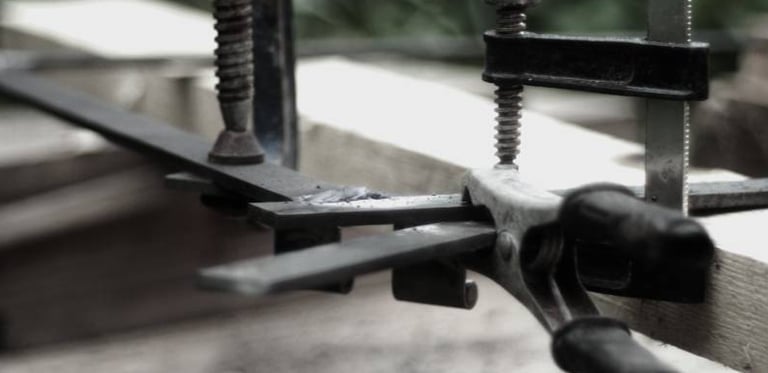
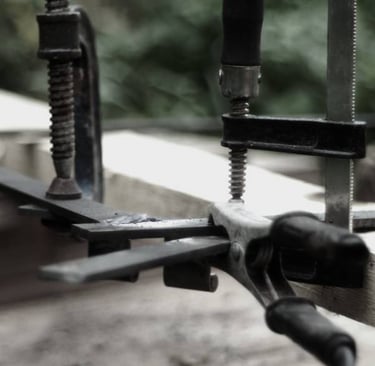
Fortunately, Paul had some bits and pieces that worked. He managed to get the blade off a bench saw and replace it with a metal-cutting grinder disc, and this meant that we could cut lengths of steel that were accurate to less than a millimetre.
Our working conditions were a bit grim at times; the days were either clear and very cold or a little warmer and very wet. I don't like arc welding indoors, especially in a situation where there’s sawdust and wood shavings about, as welding produces lots of sparks, as well as splatters of molten metal that can roll away and hide under a nice pile of wood, ready to start a fire.
When I do have to weld indoors, I surround my work area with thick heavy blankets soaked in water. They catch any sparks and put them out. But here we were a bit short of the right material, so it was the outdoor life for me.
Progress was good and we cracked on. I had to lash up a couple of clamps and some spare steel to act as a rigid support for each weld as it cooled. If you weld a joint then just leave it, the metal will contract as it cools and the contraction will pull things out of shape; you start with something that’s all nice and square and then suddenly it’s not square anymore.
The trick is to keep everything clamped up tight as it cools, preventing the distortion by getting the weld to stretch. This way, the frame keeps its shape as the weld cools.
I beveled the edges of the steel joints front and back so I could get a good bite into the steel of the frame, and then once it was finished, I was able to grind off the top of the weld, leaving a nice clean joint.
Another challenge was the hinges. They were made of mild steel cut into thirds to create a single pivot. The steel was only about 2mm thick, which is approaching the lower limit of what you can arc-weld. You can easily blow a hole through thin steel with an arc welder.
One of the things that helps in these situations is to draw the heat away. We were using a small piece of angle iron to act as a jig for the back of the hinge to keep it square while welding, and this also acted as a heat sink to stop the thin steel from over-heating and burning through.
We eventually had to move indoors when it started to rain and I could no longer feel my feet. Things moved along quite nicely, and we managed to complete about a third of frames Paul needed, all made to size and with hinges. The only thing we had to add was bars to go across some of the windows to support the lead and glass and prevent them from blowing out in a storm.
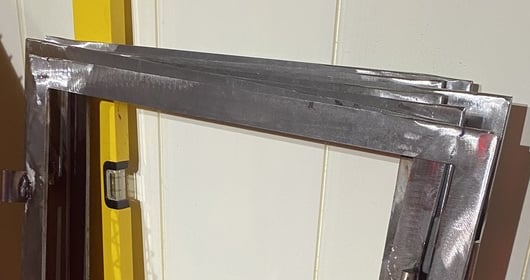
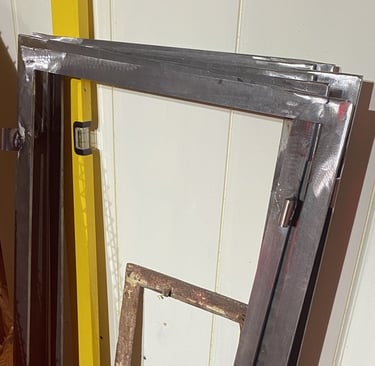
And here is one of the steel frames that Paul fixed into a wooden window. Now all it needs is some paint and its leaded glass and it’s good to go. You can't get much more medieval than that.

All in all, a good result. The windows look great. We will make another batch after Christmas and that should be all the windows done.
And there was a bonus. Paul is staying in place just down the road – a tiny little cottage like a doll’s house with a staircase in a cupboard. It has a lovely little fireplace and I got to indulge in one of my favorite pastimes, cooking on open fires. This is me making bread on his fire.
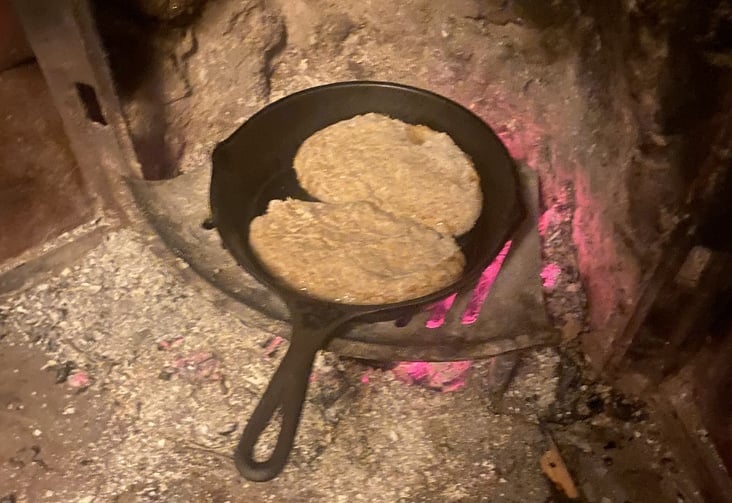
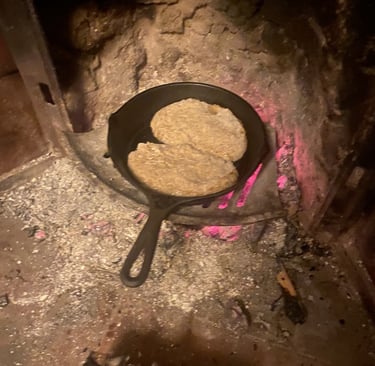
Cooking on fires is not just medieval but primeval. I think it’s in our DNA to cook like this and I’ve done a lot of it, but that’s for another blog post.
Cheers,
John